Existen ciertos temas, como pulsiones, que se encuentran tan enquistados en los arrecifes del carácter humano, que vuelven a surgir a la superficie a pesar de haber sido suprimidos en el pasado a expresiones mínimas. La genuina tendencia humana a creer en algo, por ejemplo, por más que haya sido por décadas desplazada, permanece, quizás carente de objeto correcto o expresión clara. Pero persiste. Si acaso los objetos de la creencia o culto hoy, los pequeños dioses, son el consumo, el éxito, el cultivo del cuerpo o el aparentar en redes sociales, eso parece ser otra historia. Pero una historia cierta.
Sociológicamente, ciertos arquetipos fueron desplazados; el ágora es un aforo virtual, la autoridad una amenaza, la jerarquía una opresión, la política un vacío, y la individualidad un culto en sí mismo, cada vez más desencajado de su herencia colectiva.
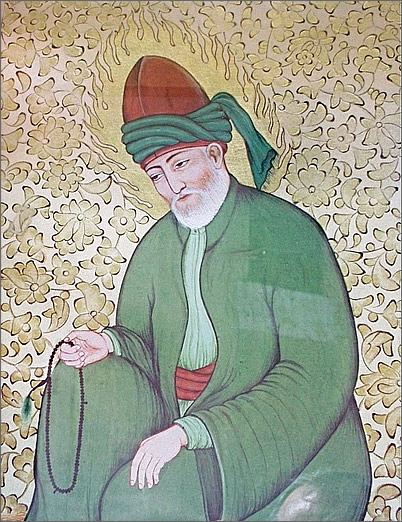
En este horizonte de resignificación del valor de costumbres y objetos, existe un poeta con una clarividencia conmovedora. La materia de su poesía es de una calidad tan prístina y esencialmente humana, que habla a pesar de haber sido escrita en la Persia del siglo XIII, y hoy sigue atesorando un mensaje cuyo cofre merece volver a ser abierto. Su manera de creer en algo, la forma en que ello encuentra cabida en cuanto a expresión artística, es tan honda que contagia a los lectores sin que el foco de la atención se fije en la corriente religiosa que cada cual practique, sino en la belleza de creer en algo.
La obra de Jalal ad-Din Muhammad Rumi requiere una primera prevención relativa a la proliferación de citas y poemas atribuidos falsamente a su autoría. La era de las comunicaciones ha llevado a que ocurrentes falsificadores atribuyan en sus Blogs o páginas web citas y poemas que el poeta Sufi nunca escribió, las cuales no resultan siempre fáciles de detectar. La propagación de ofertas relativas a autoayuda y planteamientos pseudofilosóficos para mejorar la vida de las personas como forma de negocio han agudizado la tendencia a citar sus versos en contextos utilitarios y, muchas veces, a torcerlos o derechamente falsearlos. De la amplia gama de traducciones y antologías de su obra, el trabajo ejecutado en tres tomos por el experto Nader Khalili es de destacar.
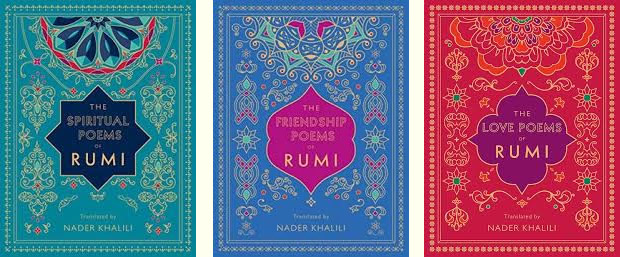
Le lectura de los poemas de Rumi enaltece una vez más temas como la amistad, el amor, la espiritualidad, la alegría y la muerte. Como sabemos, toda buena conversación tematiza necesariamente alguno de ellos. A través de sus versos vuelve a cobrar importancia la verdadera amistad como un árbol de raíces compartidas que terminan alimentándose de un corazón donde ya no existe el tú o yo. La alegría existente en dedicar aunque sea algunos minutos en disminuir el sufrimiento de los demás. Nuestra llegada al mundo como niños, el paso del tiempo entre gente querida y nuestro final como nubes temporales arrastradas por el viento. El valor del silencio, el saber callar, como un pasaje secreto que conecta nuestra boca con nuestro corazón. El deber de los felices de compartir su felicidad en un mundo que se atrofia y aísla. La necesidad de enamorarse de la agonía del amor y no del éxtasis, porque el éxtasis es volátil, y el amor —como nosotros— está siempre muriendo.
Los poemas de Rumi, ya en el siglo XIII, demuestran que quienes creen, creen con la misma materia y experimentan el albor de las mismas luces. De su voz y el contenido de sus versos es prácticamente imposible saber si su canto invoca a Alá, Javé, Cristo, Buda, la esperanza de los masones, o la disciplinada bondad de los estoicos. Si su trabajo dijese hoy solo una frase, esta estaría relacionada a la afirmación respecto a que quienes creen en algo se encuentran transitando un mismo camino y, por tanto, es iluso pensar que vale la pena excluirse, recriminarse o desplazarse. El creyente, con independencia de su credo, tiene más en común que a quien rinde pleitesía al estatus y el consumo. La experiencia de la frase antes indicada, la obra de este poeta en su generalidad —en un momento en que su país está siendo bombardeado y sus connacionales asesinados por el gobierno— es un canto dorado.
Porque la civilización avanza, o piensa que avanza, pero ciertos hitos perduran al costado o en un nivel sobre la ruta, y de vez en cuando se encienden y vuelven a echar luz sobre los derroteros. Esa es la nobleza del buen arte, que a menudo es simple. La respuesta al sentir común en el contexto de la multirreligiosidad, sobre todo hoy en Europa o en Medio Oriente, se encuentra en parte en la obra de Rumi asi como las herramientas para lidiar con el exceso de medios de comunicación, redes sociales y ofertas de consumo se encuentra acaso en la filosofía de los estoicos.
Ahora, uno de sus poemas titulado De vez en cuando, que podría estar escrito en la frente de la convivencia pacífica de los credos:
De vez en cuando
Me escondo o aparezco
De vez en cuando
Soy musulmán, judío o cristiano
Hasta que mi corazón se vuelva
Parte de cada corazón
Apareceré cada día
Con un rostro distinto[1]
[1] La traducción es mía, tomada de la antología The Friendship Poems of Rumi del traductor Nader Khalili, Wellfleet Press, New York, 2020.

Rumi
There are certain themes, like impulses, that are so deeply embedded in the reefs of human character that they resurface despite having been suppressed in the past to minimal expressions. The genuine human tendency to believe in something, for example, even if displaced for decades, remains—perhaps lacking the correct object or a clear expression. But it persists. If today the objects of belief or worship, the little gods, are consumption, success, body cultivation, or appearances on social media, that seems to be another story. But a true story nonetheless.
Sociologically, certain archetypes have been displaced; the agora is now a virtual forum, authority a threat, hierarchy an oppression, politics a void, and individuality a cult unto oneself, increasingly detached from its collective heritage.
Within this horizon of re-signifying the value of customs and objects, there exists a poet of moving clairvoyance. The substance of his poetry is of such pristine and essentially human quality that it speaks to us despite having been written in 13th-century Persia, and even today it still treasures a message whose chest deserves to be reopened. His way of believing in something, the way that belief finds expression through art, is so profound that it moves readers regardless of the religious tradition they practice; the focus shifts not to creed, but to the beauty of believing in something.
The work of Jalal ad-Din Muhammad Rumi requires an initial caution regarding the proliferation of quotes and poems falsely attributed to him. The age of communications has enabled clever forgers to attribute to the Sufi poet, on blogs and web pages, quotes and poems he never wrote—fabrications that are not always easy to detect. The spread of self-help offerings and pseudo-philosophical approaches aimed at improving people’s lives as a form of business has intensified the tendency to quote his verses in utilitarian contexts and, many times, to distort or outright falsify them. Among the wide range of translations and anthologies of his work, the three-volume effort carried out by the expert Nader Khalili deserves special mention.
Reading Rumi’s poems once again elevates themes such as friendship, love, spirituality, joy, and death. As we know, every good conversation necessarily revolves around one of them. Through his verses, true friendship regains importance as a tree with shared roots nourished by a heart where “you” and “I” no longer exist. The joy found in dedicating even a few minutes to lessening the suffering of others. Our arrival into the world as children, the passage of time among loved ones, and our end as temporary clouds carried by the wind. The value of silence, of knowing when to remain quiet, as a secret passage connecting our mouth with our heart. The duty of the happy to share their happiness in a world that grows increasingly atrophied and isolated. The need to fall in love with the agony of love rather than its ecstasy, because ecstasy is fleeting, while love—like us—is always dying.
Rumi’s poems, already in the 13th century, demonstrate that those who believe do so with the same substance and experience the dawn of the same lights. From his voice and the content of his verses, it is practically impossible to know whether his song invokes Allah, Yahweh, Christ, Buddha, the hope of the Freemasons, or the disciplined goodness of the Stoics. If his work were to say only one thing today, it would be this: that those who believe in something are walking the same path, and therefore it is foolish to think exclusion, reproach, or displacement are worthwhile. Believers, regardless of creed, have more in common with one another than with those who pay homage to status and consumption. The lived truth of that statement—his work as a whole, at a moment when his country is being bombed and his compatriots killed by the government—is a golden song.
For civilization advances, or thinks it advances, yet certain milestones endure beside the road or above it, and from time to time they ignite and cast light once more upon our paths. That is the nobility of great art, which is often simple. The answer to the common unease surrounding multireligious coexistence—especially today in Europe and the Middle East—can partly be found in Rumi’s work, just as the tools for dealing with the excess of mass media, social networks, and consumer temptations may perhaps be found in Stoic philosophy.
Now, one of his poems, titled Now and then, which could well be written across the forehead of peaceful coexistence among faiths:
Now and then
Now and then
I hide or show up
Now and then
I am Moslem, Jew, or Christian
Till my heart becomes
Part of every heart
I will appear each day
With a different face[1]
[1] The Friendship Poems of Rumi del traductor Nader Khalili, Wellfleet Press, New York, 2020, p. 33.